The Floer Jungle: Charting the Development of a Theory
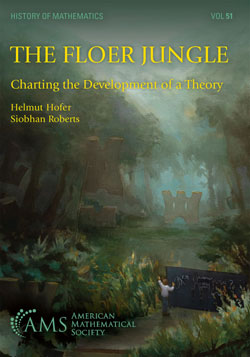
The Floer Jungle traces the development of Floer theory while portraying the life of mathematician Andreas Floer (1956–1991), whose ideas transformed geometry and topology. Blending mathematical exposition with biography, it reconstructs the existing ideas, and introduces the main characters, describing their interactions, their judgements and attempts, wrong or right. Aimed at graduate students, researchers, and scientifically curious readers, it emphasizes examples over formalism and offers appendices and references for deeper study. The book is both an engaging introduction to sophisticated mathematics and an intimate portrait of the people who pursue it.
The mathematical narrative is aimed at readers with a strong foundation—graduate students in mathematics, physics, and engineering; researchers across disciplines; and, more broadly, those with a serious scientific curiosity.
“The Floer Jungle is a first-hand account of the birth of a new mathematical field, and at the same time a touching memorial to its creator—both depicted with a richness and complexity that is far too often absent in our textbooks and papers.”
—Akshay Venkatesh, Institute for Advanced Study
“The subject of symplectic mathematics, a modern development of classical mechanics, was completely transformed by the development of Floer theory. The ideas connect even long-standing problems like the three-body problem with modern developments in topology—I haven’t been to a seminar in the subject which did not use it as a tool. The Floer Jungle explains this development, connects it with the tragic personal life of Andreas Floer, and gives clues about how the mathematical community reacts to new developments. There are very few books in mathematics which do this, despite an extensive literature of this sort in other disciplines. It is particularly timely, as many of the players (myself included) are still around to report on their memories.”
—Karen Uhlenbeck, University of Texas at Austin and Institute for Advanced Study
Buy the book